Gas Boiler
See also
Note
A gas boiler consists of one element and one controller. The element defines its physical parameters, while the controller governs the operational logic.
Create Controlled Function
- pandaprosumer.create_controlled_gas_boiler(prosumer, max_q_kw, min_q_kw=nan, max_ramp_up_kw_per_s=nan, max_ramp_down_kw_per_s=nan, heating_value_kj_per_kg=50000.0, efficiency_percent=100, allow_stop=True, max_t_out_c=nan, name=None, index=None, in_service=True, period=0, level=0, order=0, **kwargs)[source]
Creates an gas boiler element in prosumer[“gas_boiler”] and a gas boiler controller
- INPUT:
prosumer - The prosumer within this gas boiler should be created
max_q_kw (float) - Maximal heat power of the boiler [kW]
- OPTIONAL:
min_q_kw (float, default None) - Minimum working heat power of the boiler [kW]
max_ramp_up_kw_per_s (float, default None) - Maximum ramping up speed of the boiler [kW/s]
max_ramp_down_kw_per_s (float, default None) - Maximum ramping down speed of the boiler [kW/s]
heating_value_kj_per_kg (float, default 50e3) - Heating Value of the gas (amount of energy per kg of gas) [kJ/kg]
efficiency_percent (float, default 100) - Boiler Efficiency [%]
- allow_stop (bool, default True) - Whether the boiler is allowed to stop completely (reach zero power).
When False, the boiler maintains minimum power even with low demand. See edge cases documentation.
- max_t_out_c (float, default None) - Maximum output temperature constraint in °C.
When set, limits the boiler’s output temperature. See edge cases documentation for interaction with allow_stop.
name (string, default None) - The name for this gas boiler
index (int, default None) - Force a specified ID if it is available. If None, the index one higher than the highest already existing index is selected.
in_service (boolean, default True) - True for in_service or False for out of service
level (int, default 0) - The level of the controller
order (int, default 0) - The order of the controller
period (int, default 0) - Index of the period, default is 0
- OUTPUT:
index (int) - The unique ID of the created gas boiler
- EXAMPLE:
create_controlled_gas_boiler(prosumer, “gas_boiler_1”)
Controller
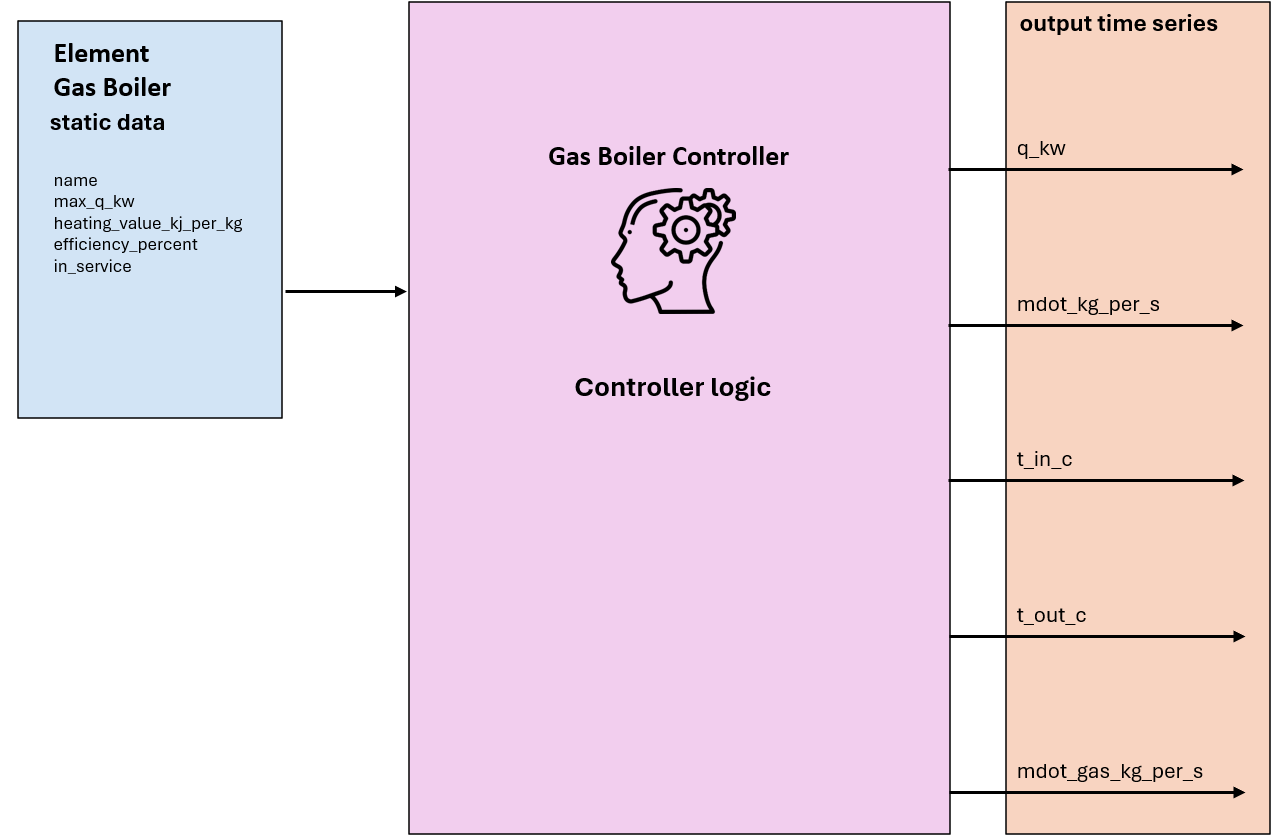
Input Static Data
These are the physical parameters required for the Gas Boiler element to enable the model calculation:
Parameter |
Description |
Unit |
|---|---|---|
name |
Unique name or identifier for the gas boiler element. |
N/A |
max_q_kw |
Maximum heat power of the boiler. |
kW |
min_q_kw |
Minimum heat power of the boiler. If the requested thermal power is positive but below this value, the boiler runs at this minimum power. |
kW |
max_ramp_up_kw_per_s |
Maximum allowed increase of thermal power between two time steps. |
kW/s |
max_ramp_down_kw_per_s |
Maximum allowed decrease of thermal power between two time steps. |
kW/s |
heating_value_kj_per_kg |
Lower heating value of the fuel used by the boiler. |
kJ/kg |
efficiency_percent |
Boiler efficiency expressed as a percentage. |
% |
allow_stop |
Whether the boiler is allowed to stop completely (reach zero power). If False, the boiler maintains minimum power even when demand is null. See Edge Cases and Constraint Interactions for important interaction with temperature constraints. |
Boolean |
max_t_out_c |
Maximum output temperature constraint. If set, limits the boiler’s output temperature to this value. See Edge Cases and Constraint Interactions for important interaction with minimum power constraints. |
Degree Celsius |
overflow_strategy |
How to dispatch surplus mass flow to responders when the boiler runs at |
str |
Input Time Series
No input (GenericMapping) needed for this controller
Output Time Series
Parameter |
Description |
Unit |
|---|---|---|
q_kw |
The provided heat power. |
kW |
mdot_kg_per_s |
The water mass flow rate through the boiler. |
kg/s |
t_in_c |
The temperature at the inlet of the gas boiler (cold return pipe). |
Degree Celsius |
t_out_c |
The temperature at the outlet of the gas boiler (hot feed pipe). |
Degree Celsius |
mdot_gas_kg_per_s |
The gas mass flow rate through the boiler |
kg/s |
Mapping
The Gas Boiler Controller can be mapped using FluidMixMapping.
No inputs are mapped, as the gas boiler does not act as a responder.
The following outputs are mapped:
mdot_kg_per_st_out_c
Model
- class pandaprosumer.controller.models.GasBoilerController(prosumer, gas_boiler_object, order, level, in_service=True, index=None, name=None, **kwargs)[source]
Controller for gas boilers.
- Parameters:
prosumer – The prosumer object
gas_boiler_object – The gas boiler object
order – The order of the controller
level – The level of the controller
in_service – The in-service status of the controller
index – The index of the controller
kwargs – Additional keyword arguments
The gas boiler model calculate the thermal power produced of the boiler and the mass flow of the gas to heat up the fluid to the demand power.
If the power consumption is higher than the maximum power of the boiler, the power consumption is set to the maximum power, and the actual output temperature \(T_\text{feed}\) that can be reached is calculated based on the maximum power. For a gas boiler, the maximum power is defined as the maximum thermal power output, representing the highest amount of heat energy the boiler can produce.
Edge Cases and Constraint Interactions
The gas boiler model includes handling of edge cases, particularly the interaction between temperature constraints and minimum power requirements:
Temperature Constraint with Minimum Power
When
allow_stop=Falseandmax_t_out_cconstraint is defined, the boiler prioritizes maintaining minimum power over strict temperature limitation. The model:First applies the temperature constraint to limit output temperature
Then checks if the resulting power would drop below
min_q_kwIf so, increases mass flow to maintain minimum power at the constrained temperature
This ensures that the boiler never violates minimum power requirements, even when temperature constraints would normally reduce power below the minimum.
Mass Flow Adjustment Mechanism
The boiler automatically adjusts mass flow in two scenarios:
Temperature Constraint Activation: When output temperature is limited by
max_t_out_c, mass flow is increased to maintain the requested powerMinimum Power Enforcement: When temperature constraints would cause power to drop below
min_q_kwwithallow_stop=False, mass flow is further increased to achieve minimum power
Physical Consistency Preservation
Throughout all constraint interactions, the model maintains:
Energy Balance: \(Q = \dot{m} * Cp * \Delta T\)
Power Limits: Respects both
max_q_kwandmin_q_kwconstraintsTemperature Limits: Never exceeds
max_t_out_cwhen setEfficiency: Maintains specified
efficiency_percentin all operating conditions to calculate the corresponding amount of fuel
Sequential Constraint Application
Constraints are applied in this order for robust behavior:
Calculate initial power based on demand
Apply ramp rate constraints (if applicable)
Apply maximum temperature constraint
Enforce minimum power constraint (if
allow_stop=False)Perform mass/energy balance adjustment
Reapply temperature constraint after balance adjustment
Example Scenario
Consider a gas boiler with:
min_q_kw = 20(minimum power)max_t_out_c = 70(maximum output temperature)allow_stop = False(the boiler cannot stop but should continuously run, so the power should remain >= min_q_kw)Demand: 0.05 kg/s mass flow at 80°C (which would require only 10.45 kW at constrained 70°C)
Results after Boiler model constraints application:
Temperature is constrained to 70°C
Power is maintained at 20 kW (minimum)
Mass flow is increased to 0.0957 kg/s to achieve 20 kW at 70°C
Result:
q_kw = 20,t_out_c = 70,mdot_delivered = 0.0957
This behavior ensures reliable operation while respecting all physical constraints.