Mappings
In pandaprosumer, mappings allow to create connections between controllers in a prosumer, or between controller in a prosumer and in a controller in pandapower or pandapipes network.
Each mapping has an initiator controller and a responder controller
Mappings are executed at the end of the initiator controller control_step to map the relevant data to the input of the responder controller.
Generic Mapping
GenericMapping provides a flexible way to map numerical data between controllers. It allows adding or subtracting values from one controller’s step results to another controller’s inputs.
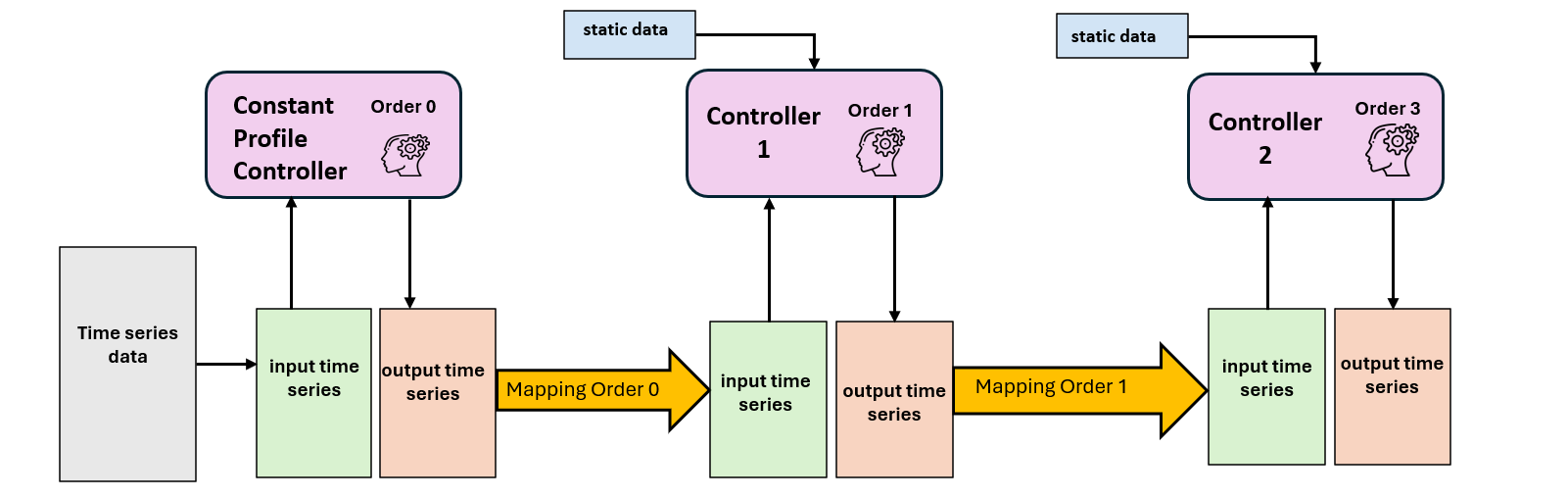
Controller interaction with Generic Mapping within prosumer
Key Features: - Supports both scalar and vector mappings. - Allows element-wise addition and subtraction operations. - Handles missing values with default replacements.
Implementation Details**
- class pandaprosumer.mapping.generic.GenericMapping(container, initiator_id, initiator_column, responder_id, responder_column, order=0, application_operation='add', no_chain=True, conversion_function=None, index=None)[source]
Generic mapping between controllers.
Map the data in initiator_column in the step results of the initiator to the responder_column input columns of the responder. initiator_column and responder_column can be strings or lists of strings with the same length
- __init__(container, initiator_id, initiator_column, responder_id, responder_column, order=0, application_operation='add', no_chain=True, conversion_function=None, index=None)[source]
Initializes the GenericWiseMapping.
- Parameters:
container – The container object (network, prosumer, energy system)
initiator_id – int - The initiating controller
initiator_column – The column in the initiating controller (string or list of strings)
responder_id – The responding controller
responder_column – The column in the responding controller (string or list of strings)
order – The order of mapping application
application_operation – The operation to apply (“add” or “subtract” - default: “add”)
no_chain – Boolean (default: True)
conversion_function – function to apply to the mapping results (default if None: identity function)
index – The index of the mapping
Methods and Functionalities
- _add_mapping(initiator_controller, responder_controller, initiator_column, responder_column)
Adds the values from the initiator controller’s result column to the responder controller’s input column.
Replaces NaN values with zero before applying the operation.
- _subtract_mapping(initiator_controller, responder_controller, initiator_column, responder_column)
Subtracts the values from the initiator controller’s result column from the responder controller’s input column.
Uses similar handling for NaN values as in _add_mapping.
GenericMapping sets the argument
no_chain=Trueby default. The no_chain attribute is a key flag that defines whether a mapping participates in controller chaining.
Fluid Mix Mapping
Fluid Mix Mapping in PandaProsumer is designed to perform mapping operations for fluid properties between controllers. Each prosumer controller is expected to maintain specific attributes for fluid data:
input_mass_flow_with_temp: A dictionary containing the fluid’s temperature and mass flow.
result_mass_flow_with_temp: A list of dictionaries (to allow one-to-many mappings) with computed fluid properties.
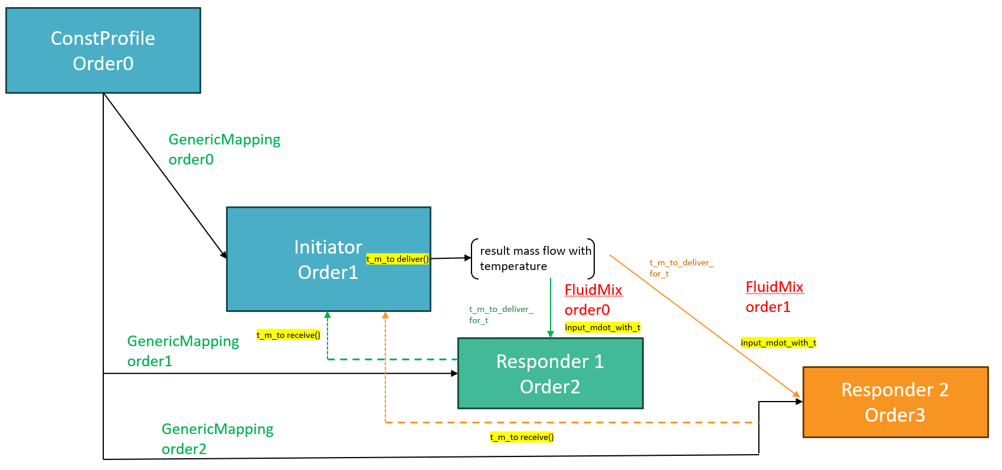
Controller interaction with Fluid Mix Mapping within prosumer
The FluidMixMapping operation performs the following steps: - Retrieves the initiator’s fluid properties (temperature and mass flow) from the result_mass_flow_with_temp list based on the specified order. - If the responder’s fluid input values (temperature or mass flow) are NaN, the initiator’s fluid properties are used directly. - Otherwise, it computes a new fluid state by:
Summing the mass flows.
Calculating the temperature as a weighted average. If the total mass flow is zero, the simple average of the temperatures is used.
The resulting mixed fluid properties are stored back in the responder’s
input_mass_flow_with_temp.
- class pandaprosumer.mapping.fluid_mix.FluidMixMapping(container, initiator_id, responder_id, order=0, no_chain=False, index=None)[source]
Fluid mapping between controllers.
Each prosumer controller has special input_mass_flow_with_temp and result_mass_flow_with_temp attributes.
input_mass_flow_with_temp is a dictionary containing the temperature and mass flow of the fluid
result_mass_flow_with_temp is a list of dictionaries (to allow 1 to many mapping)
- __init__(container, initiator_id, responder_id, order=0, no_chain=False, index=None)[source]
Initializes the GenericWiseMapping.
- Parameters:
container – The prosumer object
initiator_id – The initiating controller
responder_id – The responding controller
order – The order of mapping application
index – The index of the mapping
FluidMixMapping sets the argument
no_chain=Falseby default. The no_chain attribute is a key flag that defines whether a mapping participates in controller chaining.
Overflow Strategy: Dispatching Surplus Mass Flow
When a producer (Gas Boiler, Electric Boiler, Heat Pump) is forced onto a
thermal floor (min_q_kw / min_p_kw / min_p_comp_kw) but the
mapped responder(s) request less mass flow than that floor implies, the
_merit_order_mass_flow helper has to decide what to do with the
surplus mass flow it cannot place. The overflow_strategy parameter on
each producer element selects between three behaviours:
'dump_proportional'(default):The surplus is split across all responders in proportion to their original requests. If every request is zero, the surplus is split equally. Responders receive more mass flow than they requested, at the producer’s nominal
t_out_c/t_cond_out_c. The downstream heat demand recomputesq_received_kwfrom the received mass flow and reports a negativeq_uncovered_kwto signal over-delivery. With this default, every producer keeps mass and energy balance at the FluidMix interface - no energy leak.
'dump_on_last':The surplus mass flow is added to the last responder (lowest merit-order priority) only. Use this when one specific load is designated to absorb the over-supply (a buffer tank, a return loop, a flexible heat demand) rather than spreading it evenly.
'cap'(legacy backwards-compatible behaviour):The surplus mass flow is silently dropped. Each responder receives at most
min(its_request, what_is_left). To keep the global energy balance, the boiler controllers compensate after the dispatch by raisingt_out_cso the smaller mass flow still carries the producer’s full thermal output - the responder ends up over-supplied via temperature (e.g. 123.7 °C instead of the requested 76.85 °C). The Heat Pump cannot raiset_cond_out_c(it must respect the demand’s setpoint), so under'cap'the surplus is lost: the HP recordsq_cond_kw = min_p_comp_kw * COPwhile the responder receives only what it asked for. AnEnergyLeakWarningis emitted on every step where this happens (see below).
In every case, mass and energy balances are recomputed consistently on
both sides of the FluidMix interface: producer.t_out == demand.t_in,
producer.t_in == demand.t_out, producer.mdot == demand.mdot, and
producer.q == demand.q_received.
Note
A responder may not physically be able to absorb extra mass flow
(e.g. a radiator at a fixed setpoint). The 'dump_on_last' /
'dump_proportional' strategies do not model this - they assume
the responder accepts whatever is pushed onto it. If you sum
q_uncovered_kw to compute “unmet demand”, clamp it at zero or
that metric will be polluted by the over-delivery signal.
Note
When the demand exceeds what the producer can supply
(sum(requested) >= available), the surplus is zero and the three
strategies behave identically (standard FIFO merit order).
Implementation: the strategy is read from the producer element via
_get_element_param(prosumer, 'overflow_strategy') and forwarded to
BasicProsumerController._merit_order_mass_flow.
EnergyLeakWarning
Every producer controller (Gas Boiler, Electric Boiler, Heat Pump) calls
_check_fluid_mix_balance at the end of its control_step,
comparing the recorded mass flow to the mass flow actually dispatched to
the FluidMix responders. When they differ - i.e. when energy is silently
dropped at the interface - an EnergyLeakWarning is emitted on
that timestep with:
the producer class and controller name,
the timestep where the leak occurred,
the leak size in kW,
the producer’s recorded mdot, the dispatched mdot, and the recorded q_kw,
the active
overflow_strategy,a hint pointing to
'dump_on_last'or'dump_proportional'as the fix.
In practice this warning currently fires only when an element is
explicitly configured with the legacy overflow_strategy='cap' AND
its thermal-floor constraint is active (Heat Pump pinned at
min_p_comp_kw with a demand that requires less). Under the default
'dump_proportional' (or 'dump_on_last') it never fires. The
boilers also reconcile via t_out_c under 'cap', so they stay
silent under every strategy.
Example warning message:
heat_pump_controller 'hp1' at timestep 2020-01-01 03:00:00+00:00:
energy leak of 20.627 kW at the FluidMix interface (producer
mdot=0.258348 kg/s, dispatched=0.153090 kg/s, q_kw=50.627 kW,
overflow_strategy='cap'). Consider setting
overflow_strategy='dump_on_last' (or 'dump_proportional') on this
producer to dispatch the surplus to a responder instead.
If you understand and accept the leak (e.g. the surplus models a recirculated bypass loop not visible to your accounting), silence the warning explicitly:
import warnings
from pandaprosumer.controller.mapped import EnergyLeakWarning
warnings.simplefilter("ignore", EnergyLeakWarning)
Generic Energy System Mapping
Generic Energy System Mapping enables mapping between controllers that belong to different prosumer networks or producers.
This mapping extends the functionality of GenericMapping by allowing the responder controller to be located in a separate
prosumer. The attribute responder_net represents the target prosumer, from which the responder controller is retrieved
by its identifier.
- class pandaprosumer.mapping.generic_energy_system.GenericEnergySystemMapping(container, initiator_id, initiator_column, responder_net, responder_id, responder_column, order=0, application_operation='add', no_chain=True, conversion_function=None, index=None)[source]
Generic mapping between controllers in different containers.
Allows to map a variable to a responder controller in another container responder_net.
- __init__(container, initiator_id, initiator_column, responder_net, responder_id, responder_column, order=0, application_operation='add', no_chain=True, conversion_function=None, index=None)[source]
Initializes the GenericWiseMapping.
- Parameters:
container – The prosumer object
initiator_id – The initiating controller
initiator_column – The column in the initiating controller
responder_id – The responding controller
responder_column – The column in the responding controller
order – The order of mapping application
application_operation – The operation to apply (“add” or “subtract” - default: “add”)
no_chain – Boolean (default: True)
conversion_function – function to apply to the mapping results (default if None: identity function)
index – The index of the mapping
Fluid Mix Energy System Mapping
Fluid Mix Energy System Mapping enables mapping between controllers that belong to different prosumer networks or producers.
This mapping extends the functionality of FluidMixMapping by allowing the responder controller to be located in a separate
prosumer. The attribute responder_net represents the target prosumer, from which the responder controller is retrieved
by its identifier.
- class pandaprosumer.mapping.fluid_mix_energy_system.FluidMixEnergySystemMapping(container, initiator_id, responder_net, responder_id, order=0, no_chain=True, index=None)[source]
Fluid Mix mapping between controllers in different networks/producers.
- __init__(container, initiator_id, responder_net, responder_id, order=0, no_chain=True, index=None)[source]
Initializes the GenericWiseMapping.
- Parameters:
container – The prosumer object
initiator_id – The initiating controller
responder_id – The responding controller
order – The order of mapping application
index – The index of the mapping
Order of Mapping vs Controller Order
It is important to distinguish between the order attribute in mappings and the order of controllers:
- Mapping `order`:
Defines the sequence in which mappings are applied for a given initiator controller.
When a controller has multiple responder mappings, the order ensures that mappings are executed in a predictable and controlled order.
This is especially relevant in fluid mixing scenarios, where the final state of a responder depends on the accumulation of multiple mappings.
Note
The mapping order is local to the initiator. Each initiator can have mappings with order = 0, 1, 2, …, controlling the order in which its mappings are applied to different responders.
- Controller `order`:
Defines the execution order of controllers themselves during the simulation.
Controllers are calculated in order of their order attribute during each simulation step, regardless of any mapping logic.
Key Differences
Concept |
What It Controls |
|---|---|
Mapping order |
Order of mapping applications per initiator |
Controller order |
Execution sequence of controllers globally |
These two types of order do not influence each other directly, but together they allow for precise control over the flow and transformation of data within and across controllers.
Order Checking in PandaProsumer
To ensure consistency in the execution of controllers and data mappings within a prosumer, PandaProsumer implements order checking mechanisms. These mechanisms prevent inconsistencies in controller execution levels and ensure proper mapping sequences between controllers.
Level Checking
The level checking process ensures that all controllers within a prosumer operate at the same level, with the following exceptions:
Controllers of type ConstProfile are allowed to be executed first and are not required to have the same level as other controllers.
Controllers from pandapower or pandapipes networks are excluded from this level check.
Implementation Details: - All controllers (excluding the exceptions above) must share the same level attribute. - If different levels are found, an error is raised to prevent unintended execution sequences.
This mechanism ensures that controllers within a prosumer execute in a synchronized manner, avoiding errors due to level mismatches.
Controller Execution Order Validation
The controller order checking mechanism ensures that: - The initiator controller executes before the responder controller. - The execution order respects both the level and order attributes of controllers.
Validation Rules: 1. If the initiator controller has a higher level than the responder, an error is raised. 2. If both controllers share the same level, the initiator’s order must be lower than the responder’s order. 3. If the execution order is incorrect, an error is raised.
Mapping Order Checking
The mapping order checking mechanism ensures that the mappings between controllers are correctly structured. Each initiator must be properly mapped to its responder(s), and the mapping order must be continuous and start at zero.
Key Checks: - Each initiator controller should have a defined list of responder mappings. - The order values of mappings must be consecutive integers starting from 0. - If gaps or inconsistencies in the mapping order are detected, an error is raised.
This process ensures that data flows correctly between controllers, avoiding situations where mappings are applied in an undefined or incorrect order.
check_order Argument
PandaProsumer provides a check_order argument when creating a prosumer. This argument allows users to enable or disable order checking based on their needs.
check_order = True (default): - Enforces level checking among controllers. - Ensures mapping orders are correctly structured.
check_order = False: - Skips all order validation steps. - Can be useful in flexible configurations where strict order enforcement is not required.
By providing this option, users can balance between strict order enforcement and flexible execution, depending on their specific use case.
— These order-checking mechanisms play a crucial role in maintaining the consistency and accuracy of controller operations and mappings within PandaProsumer networks.